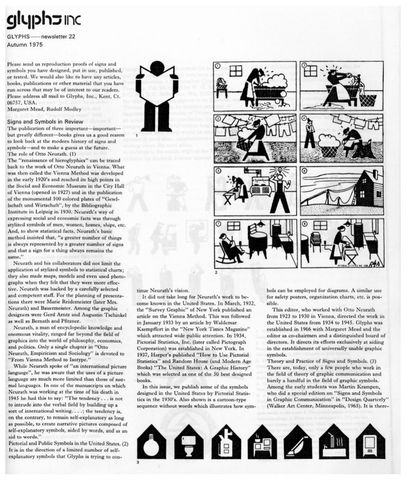
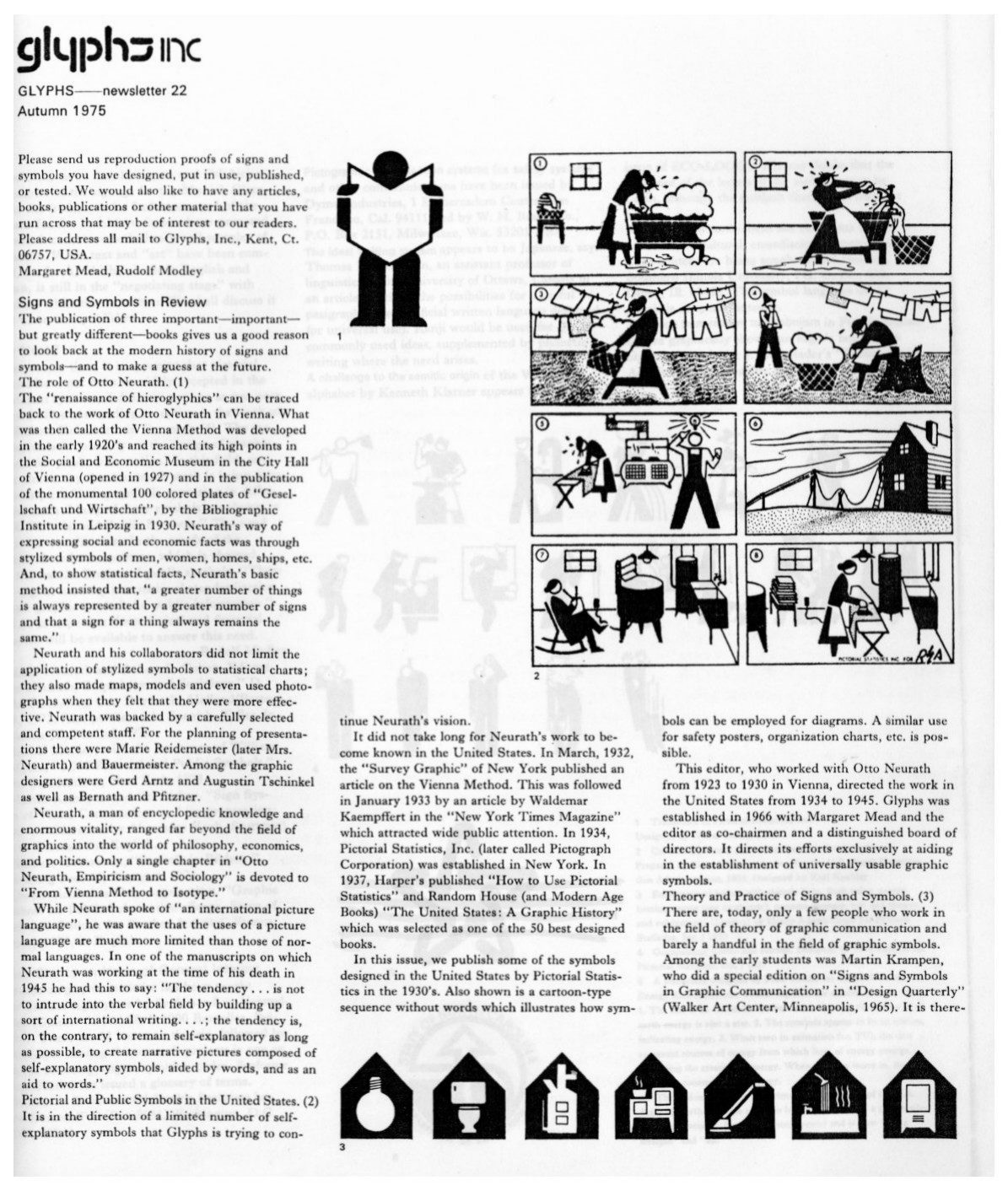
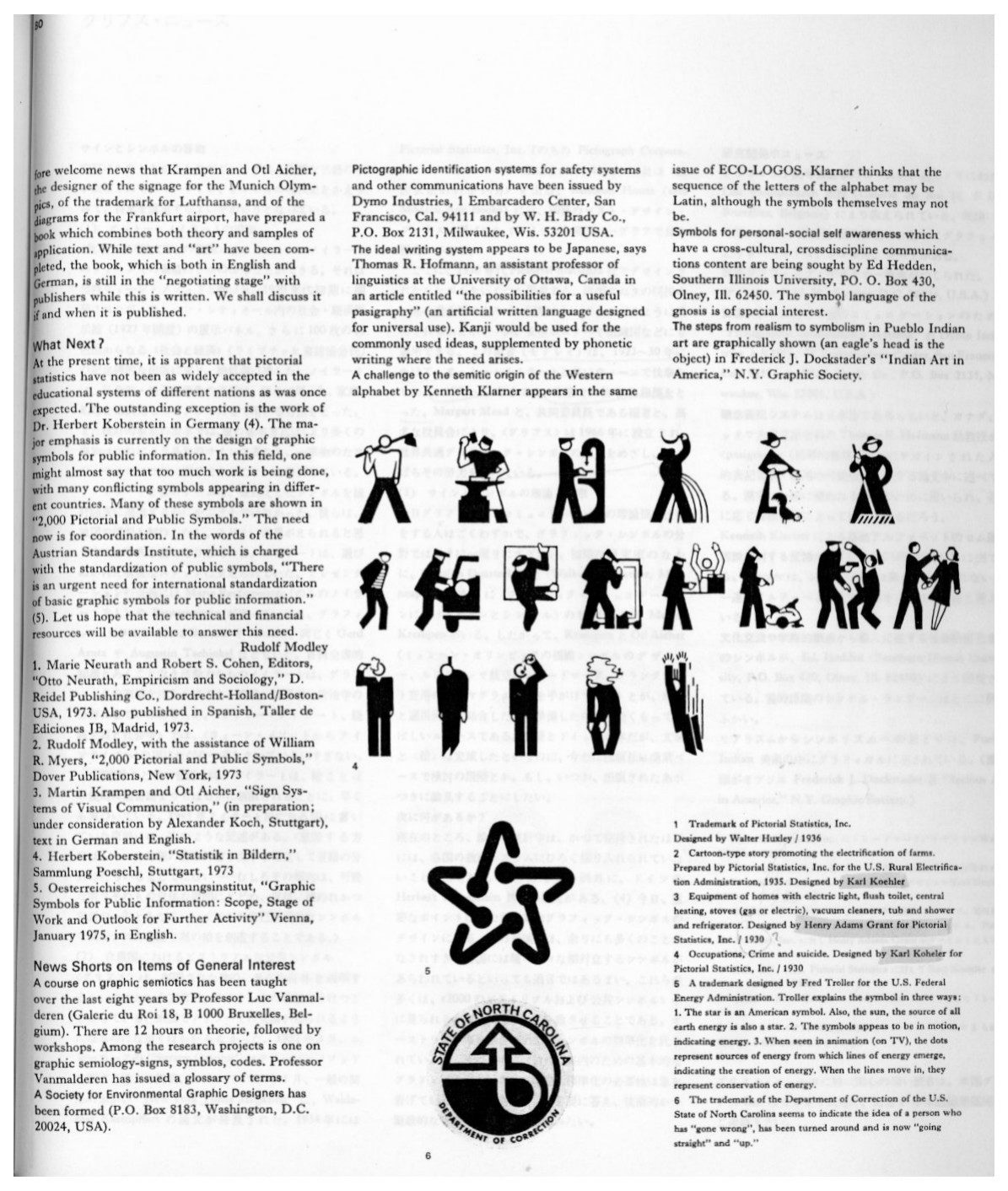
Other practitioners · Rudolf Modley Glyphs newsletter no. 22 (Autumn 1975) from Glyphs, Inc., with 'Signs and Symbols in Review' by Margaret Mead and Rudolf Modley. The review traces the modern history of signs and symbols to Otto Neurath's Vienna Method, the Social and Economic Museum (opened 1927) and the 100 plates of 'Gesellschaft und Wirtschaft'.
- Author
- Mead, Margaret; Modley, Rudolf
- Publisher
- Glyphs, Inc., Kent, Connecticut
- Year
- 1975
- Language
- English
- Text
- OCR, searchable
Text on page 1
glyphsinc
GLYPHS——newsletter 22
Autumn 1975

 Pen
Please send us reproduction proofs of signs and
symbols you have designed, put in use, published,
or tested. We would also like to have any articles,
books, publications or other material that you have
run across that may be of interest to our readers.
Please address all mail to Glyphs, Ine., Kent, Cr.
06757, USA.
Margaret Mead, Rudolf Modley

Signs and Symbols in Review
‘The publication of three important—important—
but greatly different—books gives us a good reason
to look back at the modern history of signs and
symbols—and to make a guess at the future,
‘The role of Otto Neurath. (1)
‘The “renaissance of hieroglyphics” can be traced

back to the work of Otto Neurath in Vienna, What
was then called the Vienna Method was developed
in the early 1920's and reached its high points
the Social and Economie Museum in the City Hall
of Vienna (opened in 1927) and in the public ion

of the monumental 100 colored plates of “Gesel-
Ischaft und Wirtschaft”, by the Bibliographic
Institute in Leipzig in 1930. ‘eurath's way of
expressing social and economic facts was through
stylized of men, women, homes, ships, etc.
And, to show statistical facts, Neurath’s basic
method insisted that, “a greater number of thin
is always represented by a greater number of signs

and that a sign for a thing always remains t
Archive ID ot-rudolf-modley-1975-glyphs-news · Deep zoom and record · Request removal