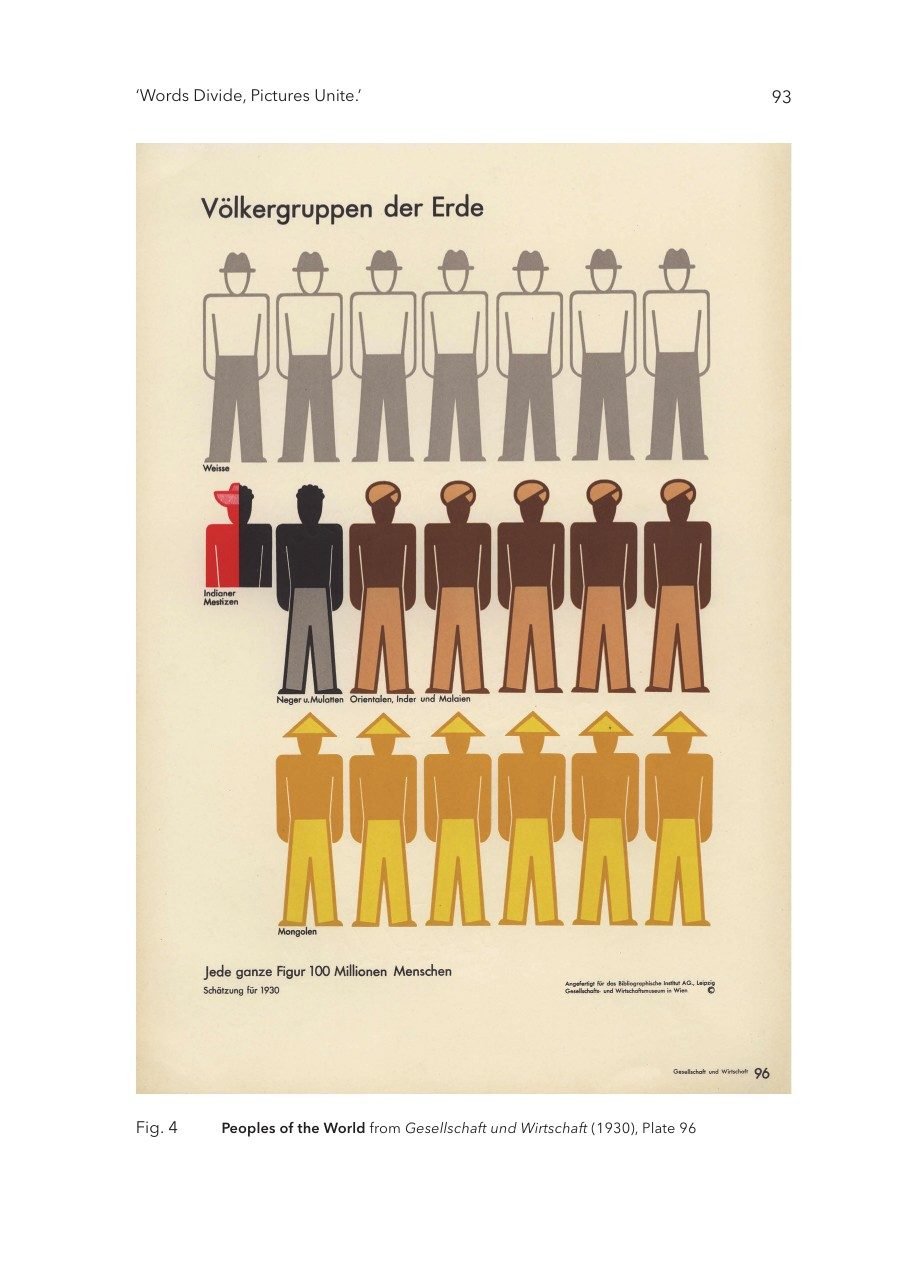
Research · Visual language Chapter in Image and Imaging in Philosophy, Science and the Arts, vol. 2, placing Neurath's pictorial statistics in Red Vienna's settlement movement and the Museum of Society and Economy, and analysing the 'Peoples of the World' chart (Gesellschaft und Wirtschaft, 1930, plate 96) as a case of how his philosophy and pictorial work went together.
- Author
- Nikolow, Sybilla
- Publisher
- ontos Verlag, Frankfurt
- Year
- 2011
- Language
- English
- Text
- From the PDF, searchable
Text on page 1
‘Words Divide, Pictures Unite.’
 Otto Neurath’s Pictorial Statistics
 in Historical Context1

 Sybilla Nikolow, Bielefeld

In keeping with his principle that ‘metaphysical terms divide, scientific terms
unite’ Otto Neurath (1882–1945) wrote in 1931 in the German teacher’s
journal Die Volksschule:

 Finally it should be noted that the picture education, especially the pictorial
 statistics, are of international importance. Words carry more emotional
 elements than set pictures, which can be observed by people of different
 countries, different parties without any protest; Words divide, pictures unite.2

For the primary aim to communicate empirical based observations Neurath
believed his method of pictorial statistics to be a useful tool to transmit rational
information across barriers of class, culture and education most effectively.
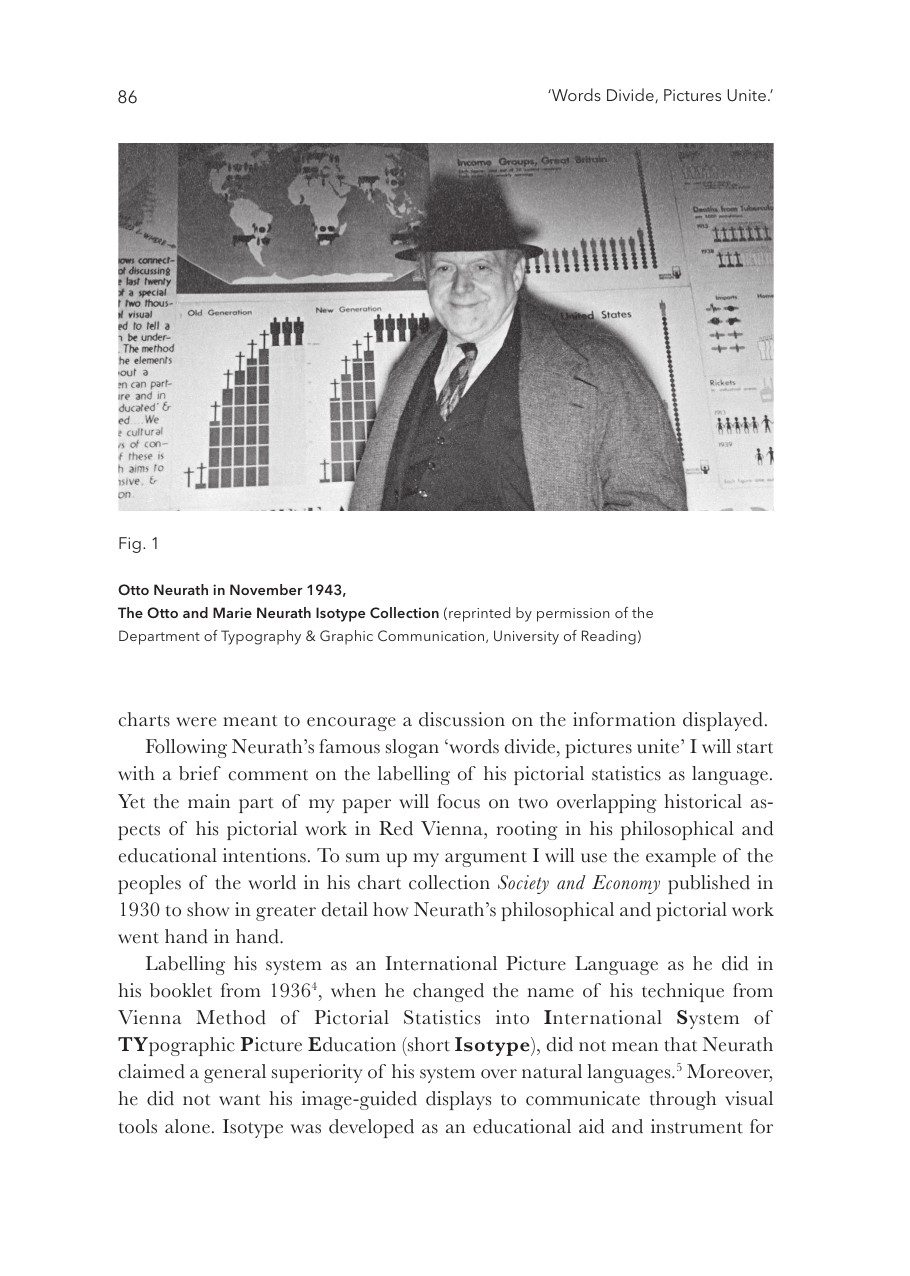
 In figure 1 overleaf one sees Otto Neurath, two years before his untimely
death in 1945, in front of a statistical chart on the occasion of an exhibition
at the London cinema screening of the documentary The World of Plenty.
The film was produced by British director Paul Rotha in cooperation with
Neurath.3 In this film animated statistical charts were extensively used to
explain the complex cycle of food production and subsequent distribution
by the nutritionist Boyd Orr. In addition to that Neurath’s method was used
as a voice-ove
Archive ID re-article-pdf-2197-5263-1-pb · Deep zoom and record · Request removal