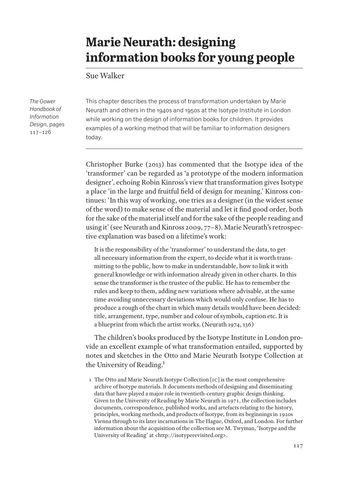
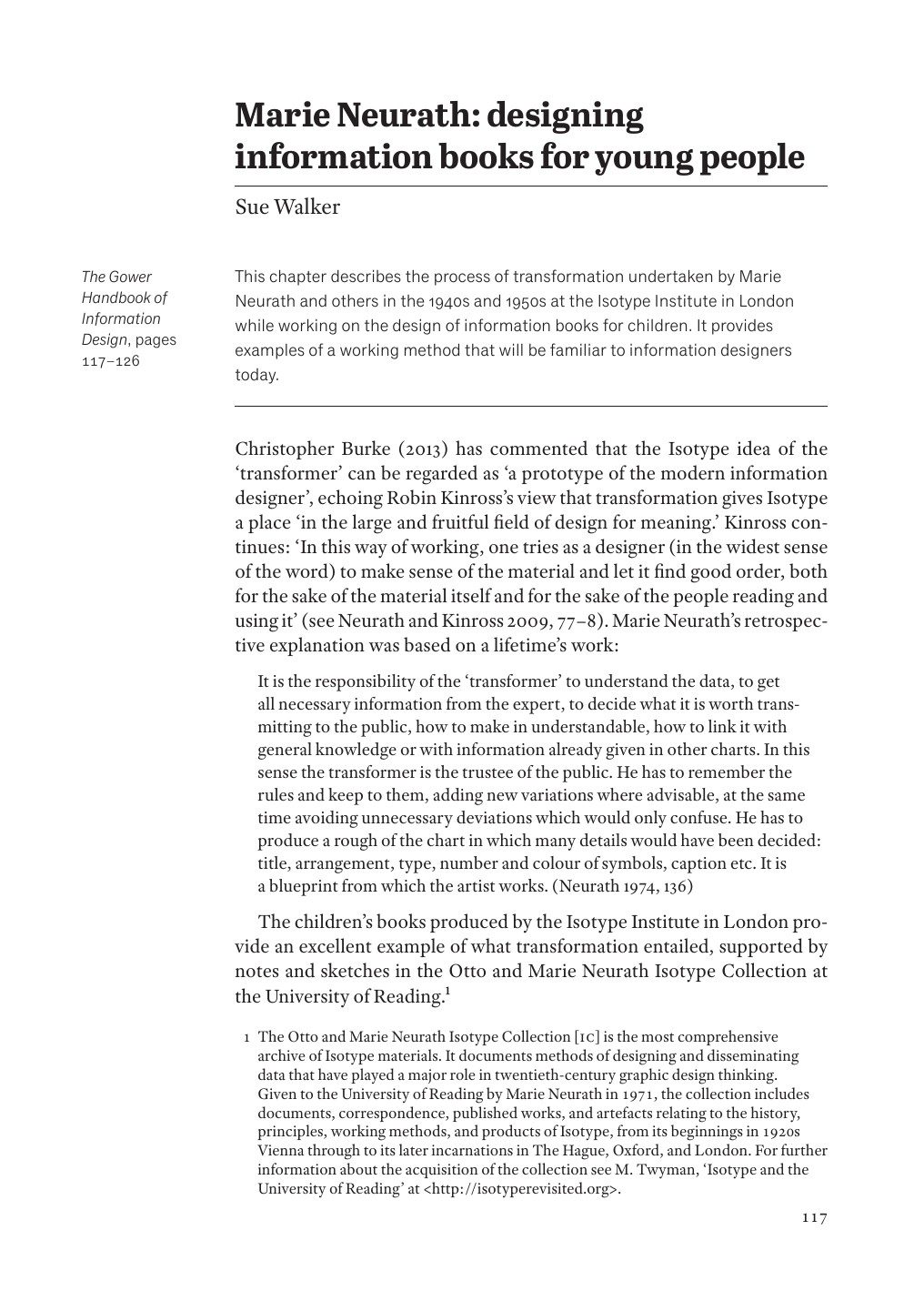
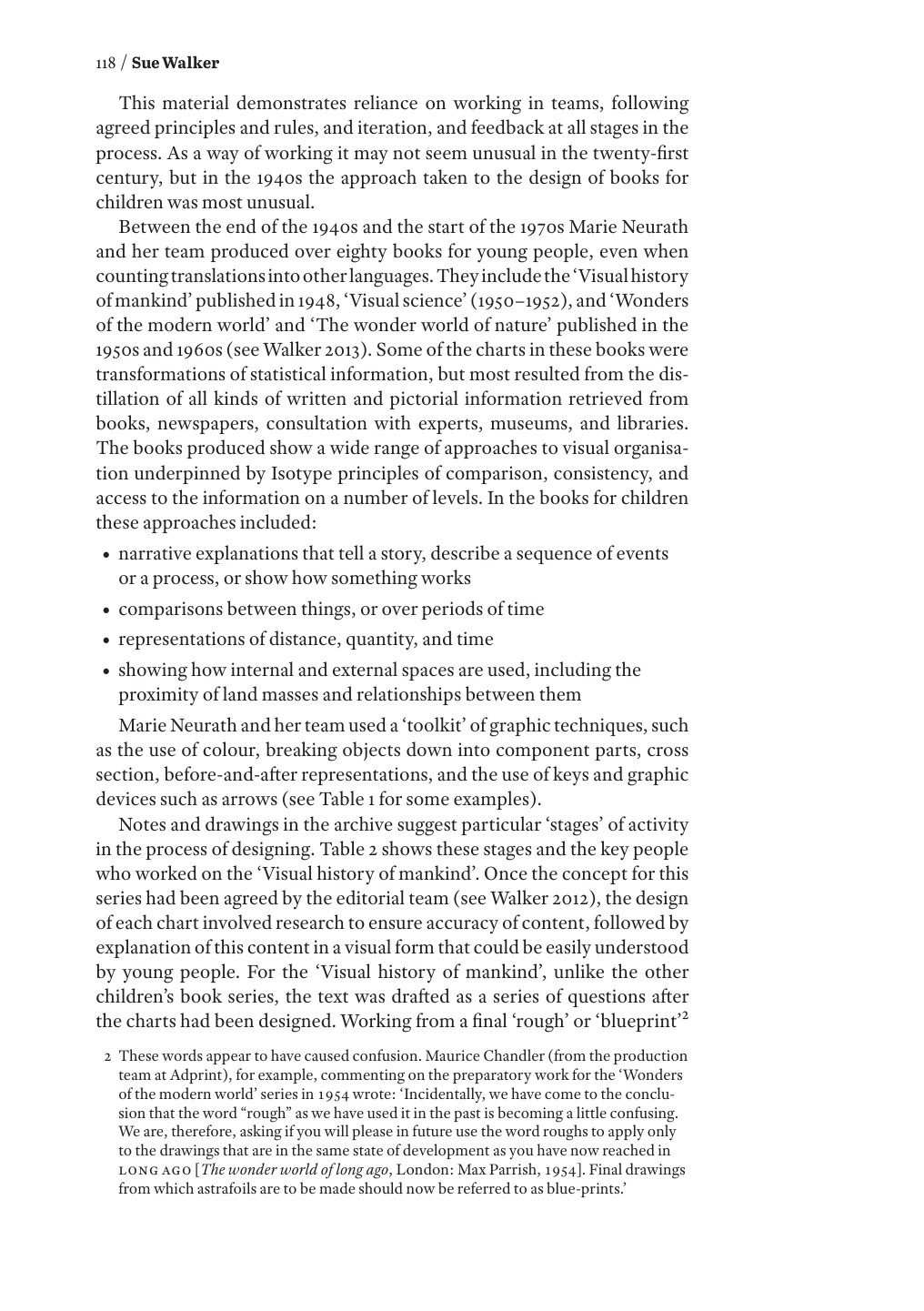
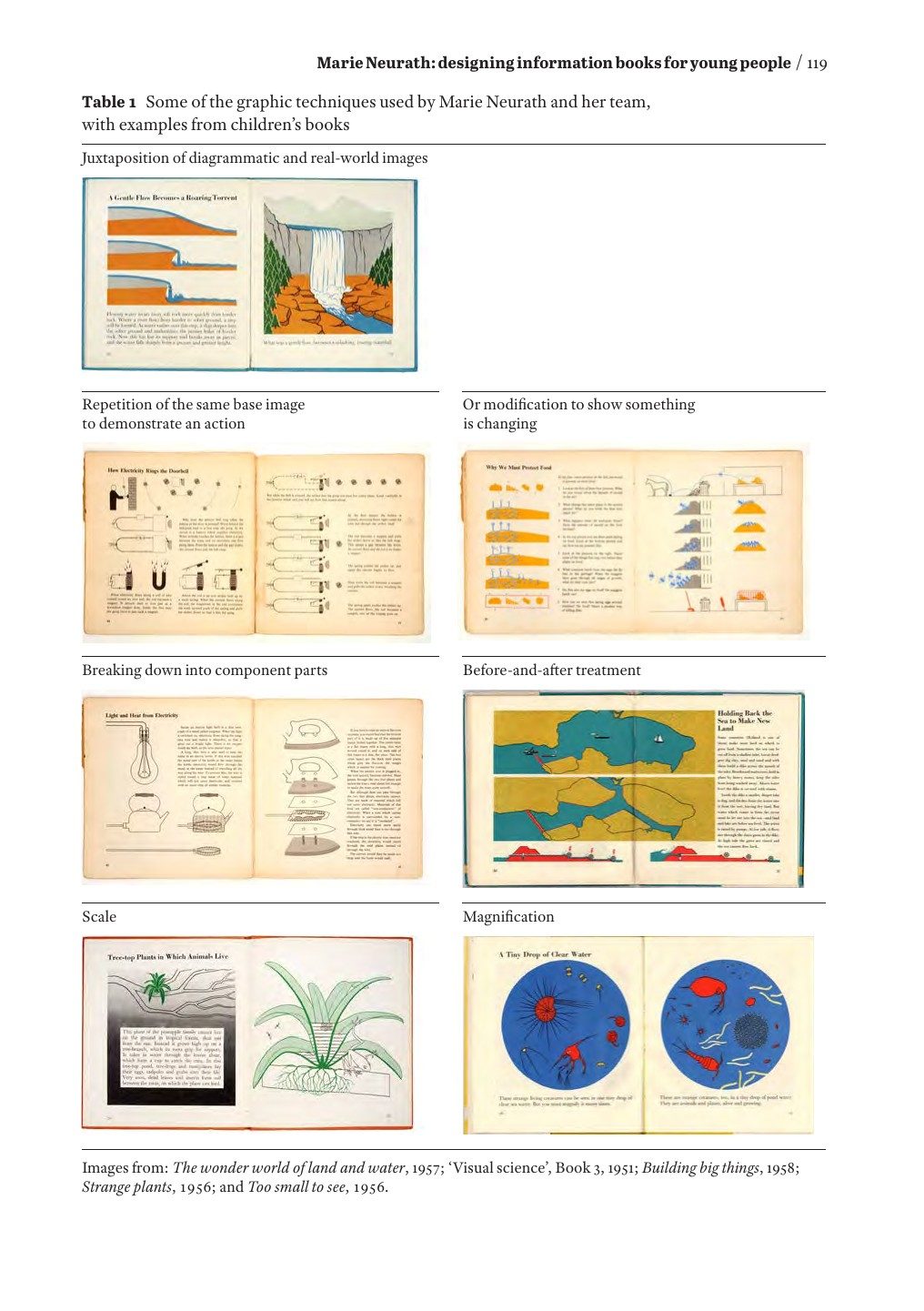
Research · Marie Neurath Chapter in The Gower Handbook of Information Design describing Marie Neurath's process of transformation for the Isotype Institute's children's books of the 1940s–1960s (Visual History of Mankind, Visual Science, Wonder World series): research, sketching in carbon-copy books, blueprints, concurrent text and image work, and feedback from experts, teachers and children.
- Author
- Walker, Sue
- Publisher
- Gower
- Year
- 2017
- Dating
- Estimated: Chapter in Information Design: Research and Practice (Gower/Routledge) pp 117-126; latest reference 2013; book dated 2017 (Dec 2016 release) (Research Lab dating, 2026-11-02)
- Language
- English
- Text
- From the PDF, searchable
Text on page 1
Marie Neurath: designing
 information books for young people
 Sue Walker

The Gower This chapter describes the process of transformation undertaken by Marie
Handbook of Neurath and others in the 1940s and 1950s at the Isotype Institute in London
Information while working on the design of information books for children. It provides
Design, pages
 examples of a working method that will be familiar to information designers
117–126
 today.

 Christopher Burke (2013) has commented that the Isotype idea of the
 ‘transformer’ can be regarded as ‘a prototype of the modern information
 designer’, echoing Robin Kinross’s view that transformation gives Isotype
 a place ‘in the large and fruitful field of design for meaning.’ Kinross con-
 tinues: ‘In this way of working, one tries as a designer (in the widest sense
 of the word) to make sense of the material and let it find good order, both
 for the sake of the material itself and for the sake of the people reading and
 using it’ (see Neurath and Kinross 2009, 77–8). Marie Neurath’s retrospec-
 tive explanation was based on a lifetime’s work:
 It is the responsibility of the ‘transformer’ to understand the data, to get
 all necessary information from the expert, to decide what it is worth tran
Archive ID re-article-pdf-designprocessmn · Deep zoom and record · Request removal