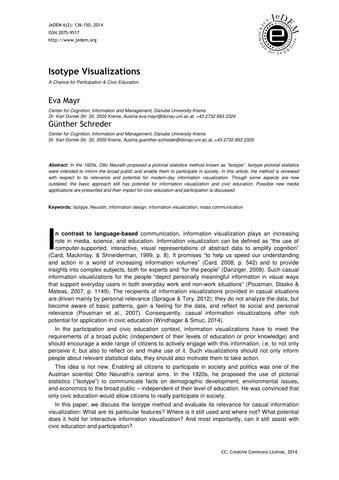
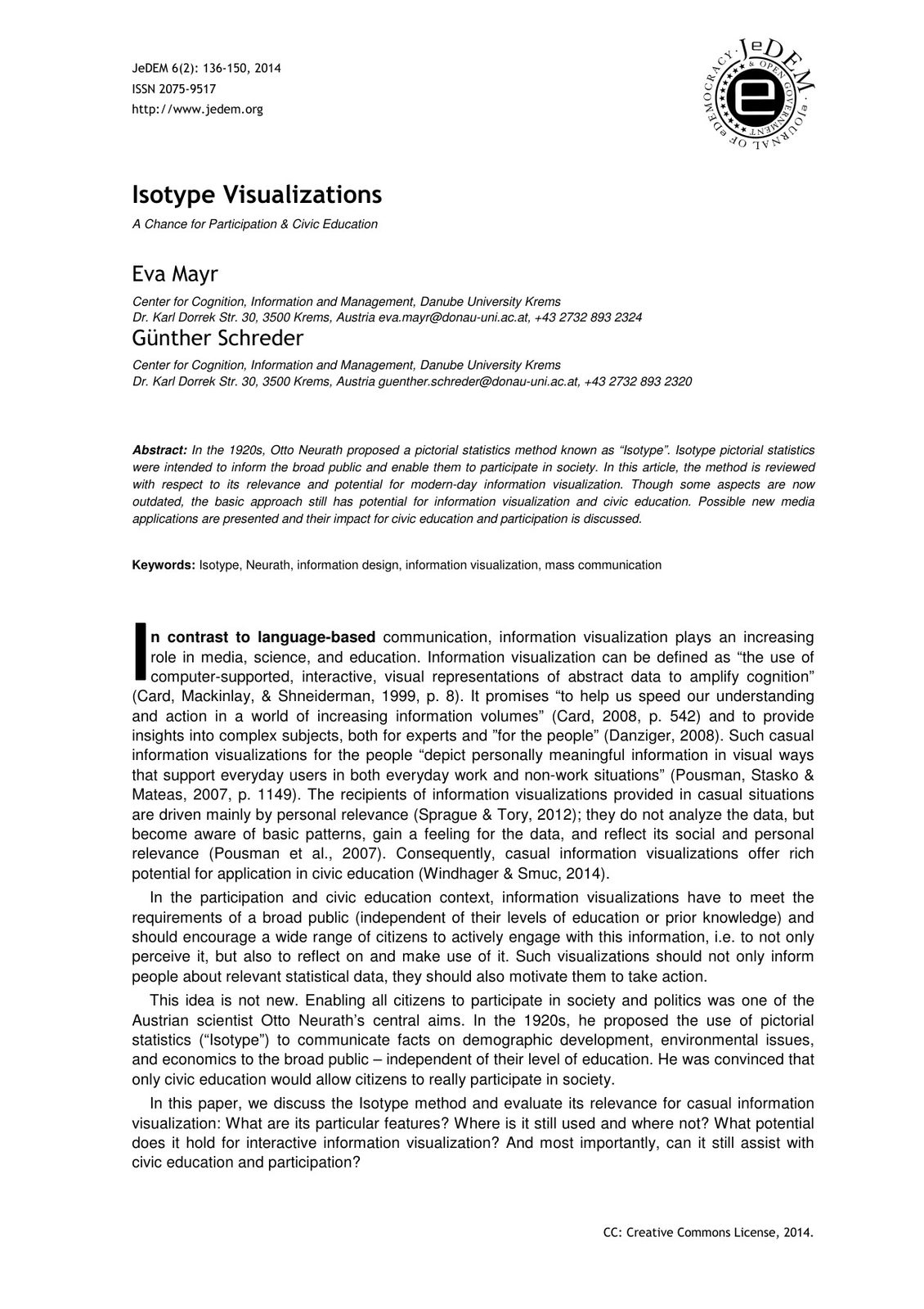
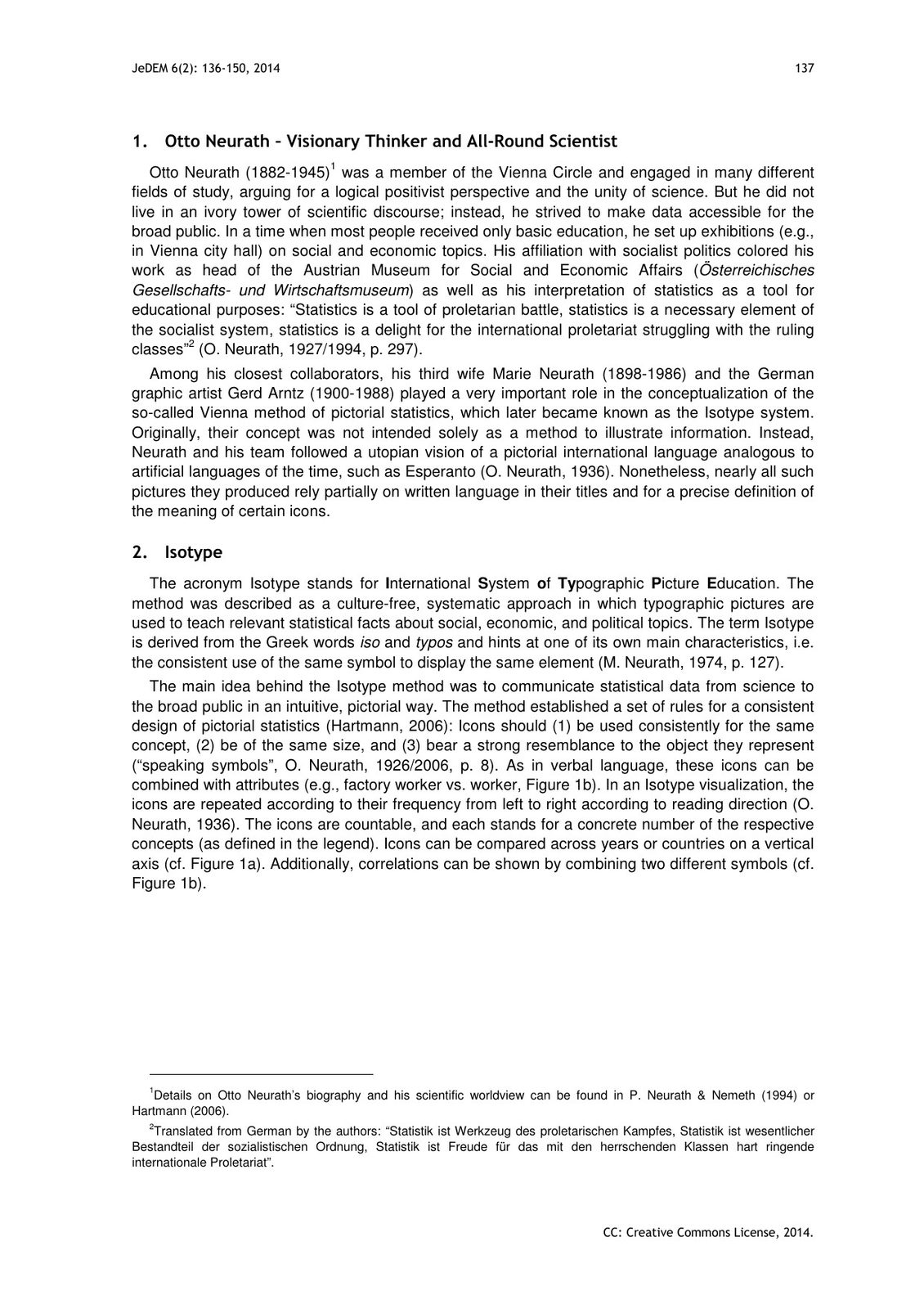
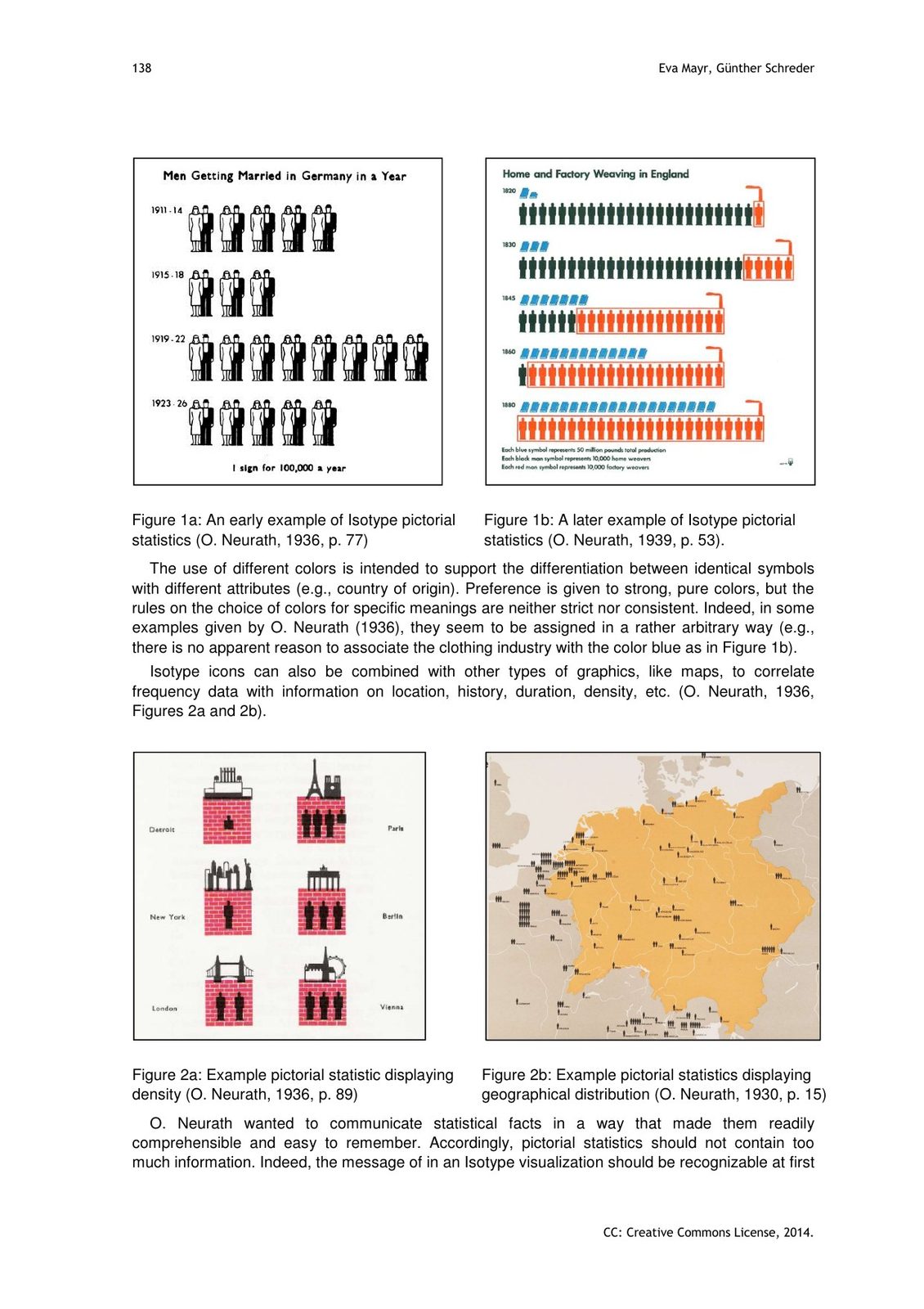
Reviews Neurath's Isotype method for its relevance to modern information visualisation, arguing that although some aspects are outdated its basic approach can serve civic education and participation, and proposes new-media applications.
Text on page 1
JeDEM 6(2): 136-150, 2014
ISSN 2075-9517
http://www.jedem.org

Isotype Visualizations
A Chance for Participation & Civic Education

Eva Mayr
Center for Cognition, Information and Management, Danube University Krems
Dr. Karl Dorrek Str. 30, 3500 Krems, Austria eva.mayr@donau-uni.ac.at, +43 2732 893 2324
Günther Schreder
Center for Cognition, Information and Management, Danube University Krems
Dr. Karl Dorrek Str. 30, 3500 Krems, Austria guenther.schreder@donau-uni.ac.at, +43 2732 893 2320

Abstract: In the 1920s, Otto Neurath proposed a pictorial statistics method known as “Isotype”. Isotype pictorial statistics
were intended to inform the broad public and enable them to participate in society. In this article, the method is reviewed
with respect to its relevance and potential for modern-day information visualization. Though some aspects are now
outdated, the basic approach still has potential for information visualization and civic education. Possible new media
applications are presented and their impact for civic education and participation is discussed.

Keywords: Isotype, Neurath, information design, information visualization, mass communication

 n contrast to language-based communication, information visualization plays an increasing
 role in media, science, and education. Information visualization can be defined as “the use of
 computer-supported, interactive, visual representations of abstract data to amplify cognition”
(Card, Mackinlay, & Shneiderman