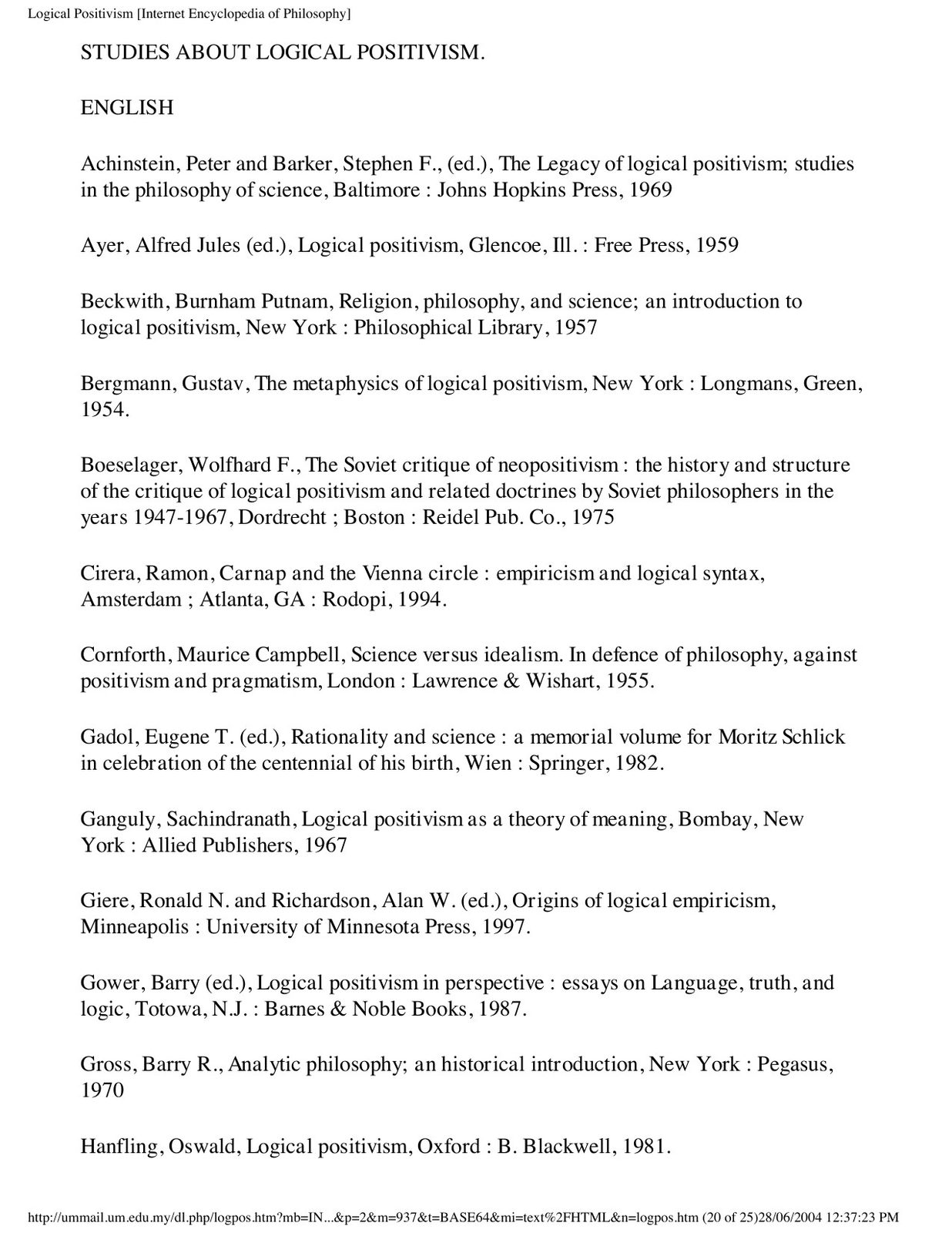
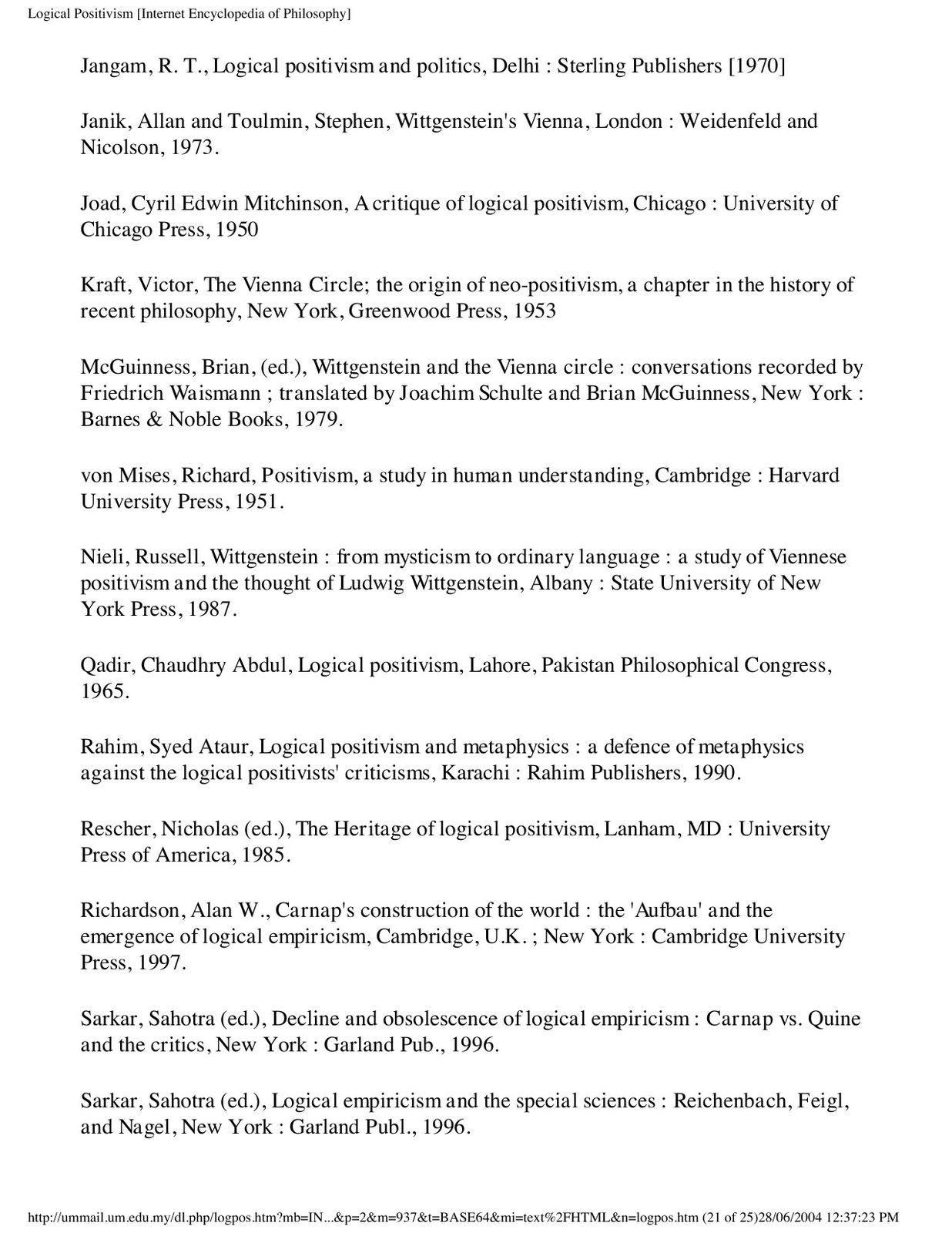
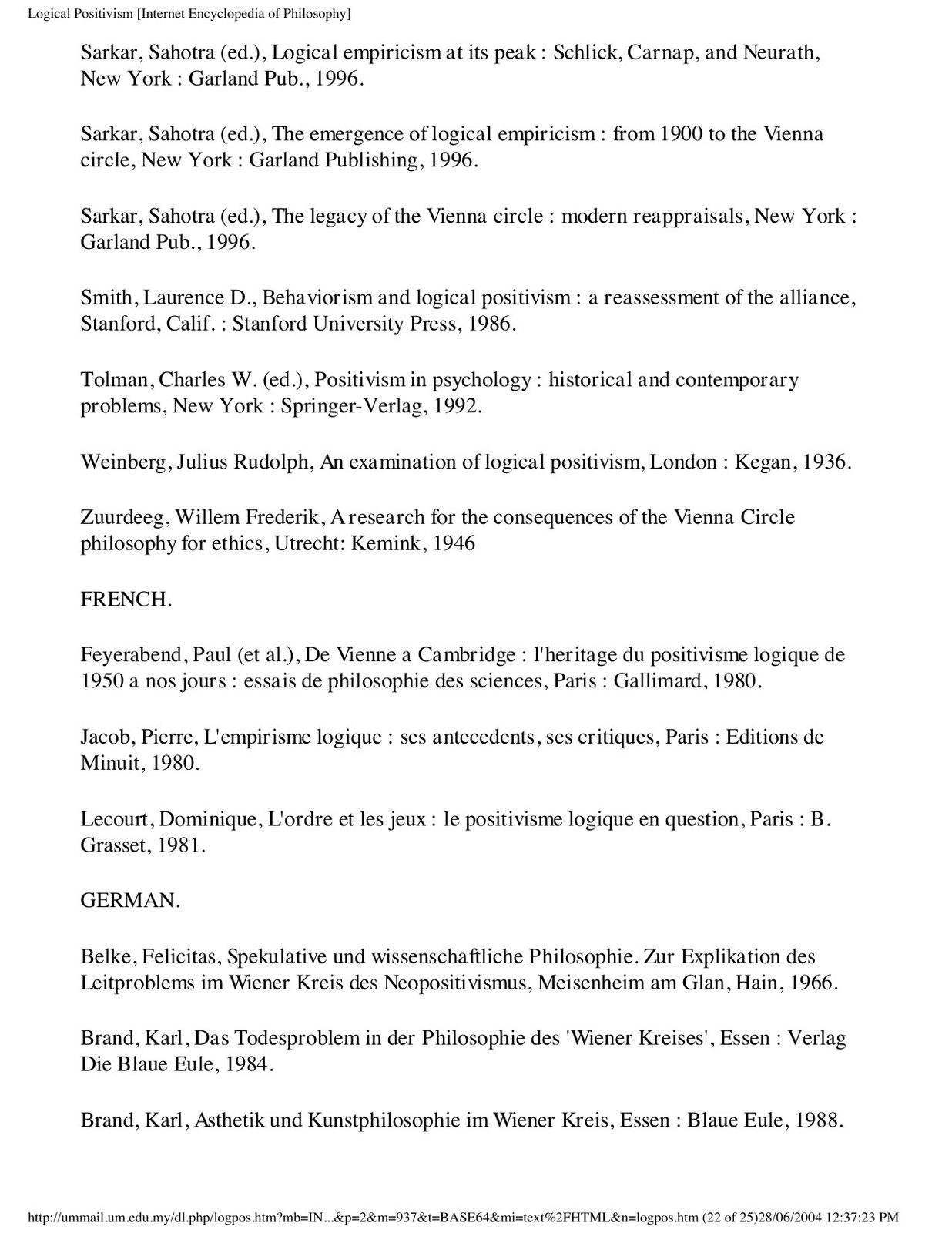
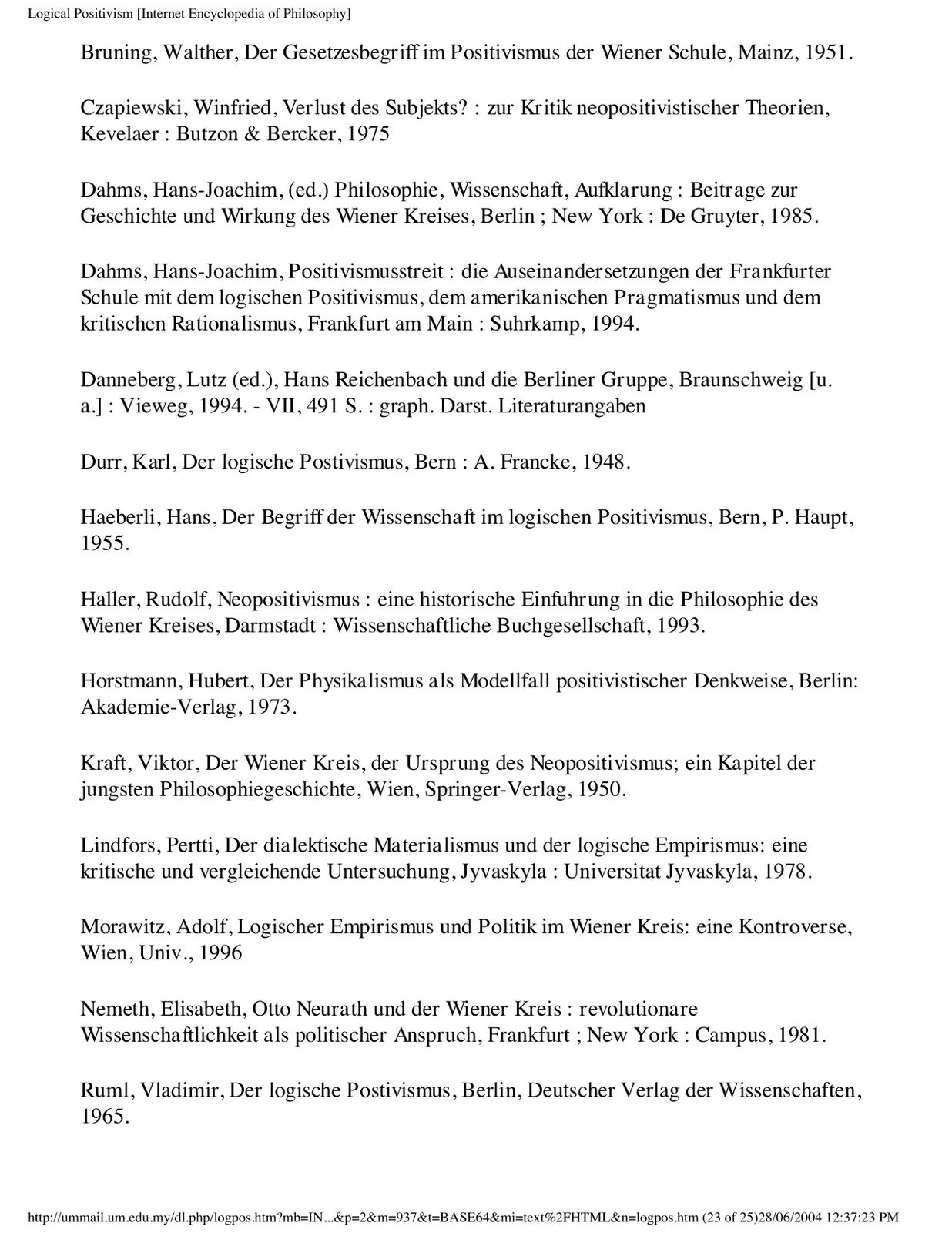
Research · philosophy Encyclopedia entry on logical positivism covering the verifiability principle, the logical structure of scientific theories and probability, with biographical notes on members of the Vienna Circle including Otto Neurath, and sections on its European and American periods and influence.
- Author
- Murzi, Mauro
- Publisher
- The Internet Encyclopedia of Philosophy
- Year
- 2001
- Language
- English
- Text
- From the PDF, searchable
Text on page 1
Logical Positivism [Internet Encyclopedia of Philosophy]

 The Internet Encyclopedia
 of Philosophy

 Logical Positivism

(Also known as logical empiricism, logical neopositivism, neopositivism). School of philosophy risen
in Austria and Germany during 1920s, primarily concerned with the logical analysis of scientific
knowledge. Among its members were Moritz Schlick, founder of the Vienna Circle, Rudolf Carnap, the
leading figure of logical positivism, Hans Reichenbach, founder of the Berlin Circle, Herbert Feigl,
Philipp Frank, Kurt Grelling, Hans Hahn, Carl Gustav Hempel, Victor Kraft, Otto Neurath, Friedrich
Waismann.

Logical positivists denied the soundness of metaphysics and traditional philosophy; they asserted that
many philosophical problems are indeed meaningless. During 1930s the most important representatives
of logical positivism emigrated to USA, where they influenced American philosophy. Until 1950s
logical positivism was the leading philosophy of science; today its influence persists especially in the
way of doing philosophy, in the great attention given to the analysis of scientific thought and in the
definitely acquired results of the technical researches on formal logic and the theory of probability.

The following paragraph (The main philosophical tenets of logical positivism) explains
Archive ID re-article-pdf-logical-positi-vis-m · Deep zoom and record · Request removal