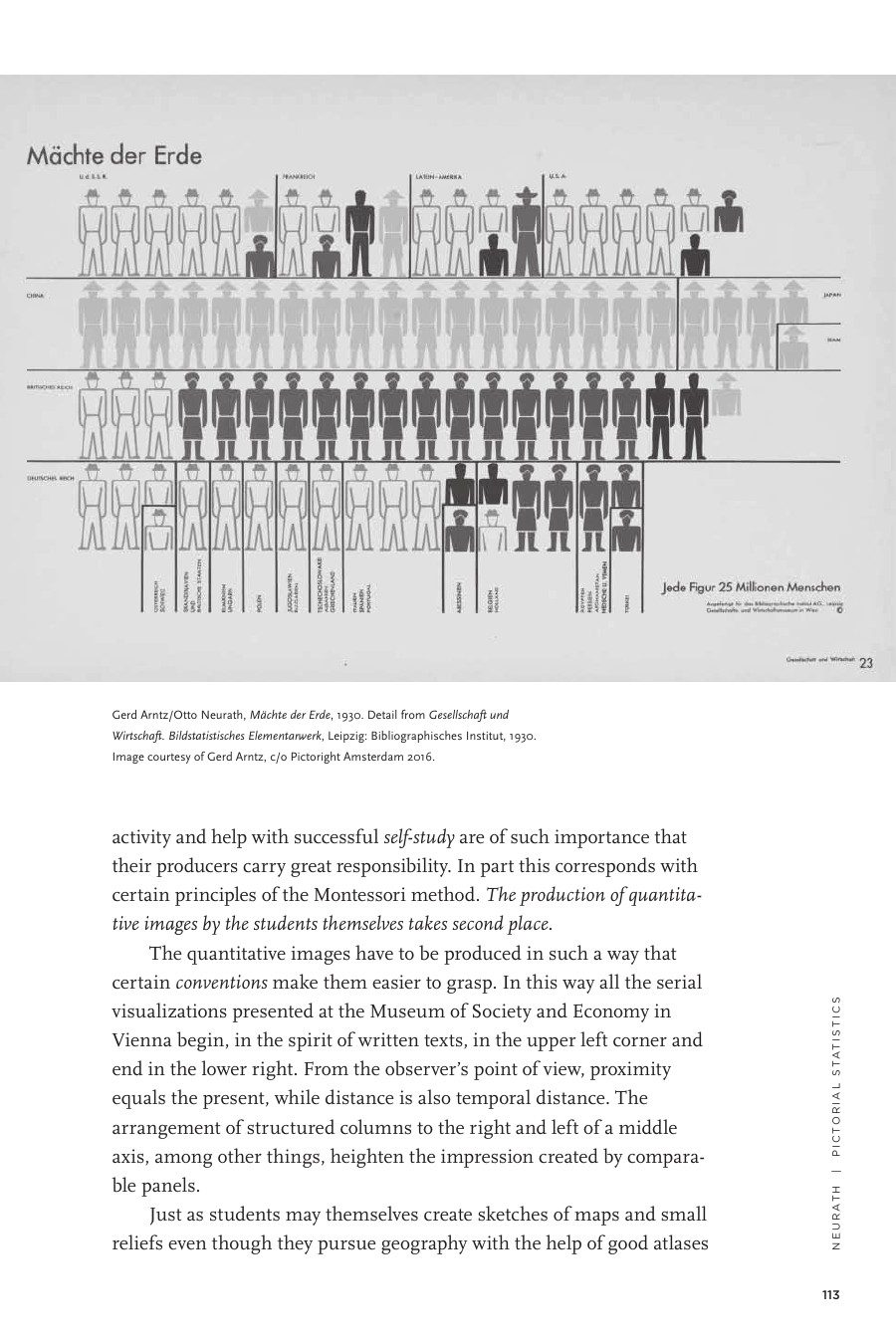
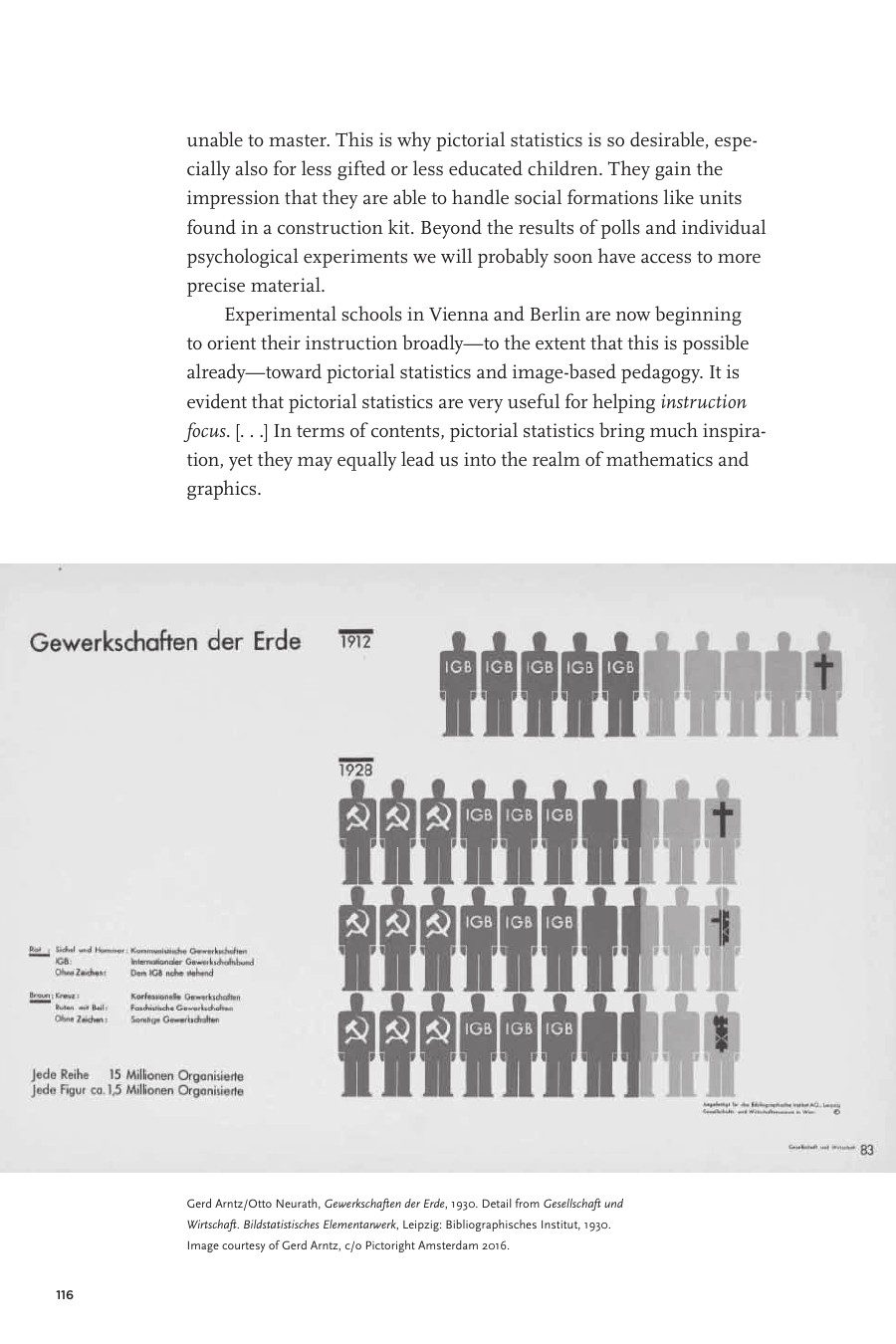
Research · Visual language English translation of Neurath's 1931 essay 'Bildstatistik nach Wiener Methode' (Die Volksschule), explaining the Vienna Method's use of repeated 'speaking signs' instead of enlarged figures, its conventions and rounding, and its use in schools, including magnetic display boards and children's own charts. Illustrated with details from Gesellschaft und Wirtschaft (1930) by Gerd Arntz and Otto Neurath ('Mächte der Erde', 'Gewerkschaften der Erde').
- Author
- Neurath, Otto; Spieker, Sven (trans.)
- Publisher
- ARTMargins (MIT Press)
- Year
- 2017
- Language
- English
- Text
- From the PDF, searchable
Text on page 1
DOCUMENT

 picTorial sTaTisTics
 folloWing The Vienna MeThod1
 otto Neurath

 Science tells us about stars, stones, plants, and animals, and likewise
 about people and their life together. Science supports its laws and
 observations based on experience.
 In its most modern incarnation, science is especially interested in
 preserving facts visually. Astronomical facts are being photographed
 directly, while the trajectories of stars, specters, and crystalline struc-
 tures are captured by photography in an indirect way. Photography
 shows us the behavior of ants and children, and even with audio
 recordings we are being acquainted through visualization. Where static
 photography is not sufficient, cinema jumps into the fray. A fleeting
 comparison between older and more recent research will teach us about
 this expansion of the visual protocol, with recording machines taking
 the place of manual entries.
 However, it is not only protocols that are using visual devices; the
 representation of results also increasingly uses them.
 Pedagogy seeks to invigorate the students’ activity not least by sub-
 jecting simple observations or scientific results to analysis, which in
 some
Archive ID re-article-pdf-neurath-o-2017-pictorial-statistics-following-the-vienna-method-artmargins · Deep zoom and record · Request removal